In this article, we get into some geeky musically scientific information. This post is also on the Healing Frequences Music webstie but here, we address the spiritual aspects of the question "Is there a key of David." When I get asked, people assume there's a specific musical key or even concert pitch (A=440, A=444, A=432 etc.) that David used. The obvious question that comes to my mind when people ask is "how would David have known what to tune to?" From what we know of history, there was no way to measure pitch at that time. This leads us to believe tuning was part intuitive and part what sounded good.
Musical Introduction
In my articles on concert pitch and temperament on the Healing Frequencies Music website, I go into greater detail on how pitch and tuning work so I'll not do that here. What we do know about historical music around the time of David (circa 1037 - 970 BCE) is that they used lyres, shofars, brass style wind instruments, types of flutes and reeded instruments, and a variety of percussion instruments (as seen in Egyptian drawings and wall paintings and mentioned in the Bible). There are bone flutes found in caves that are dated to at least 20,000 years ago that are tuned similar to the modern scale (close to equal temperament). There is also an ancient set of tuned bells from around the time of Pythagoras (circa 570 - 490 BCE) found in China (Marqui Yi of Zeng). Like the bone flutes, they are close (but not close enough) to equal temperament.
- Equal temperament is the modern standard of tuning the distance between notes. Notes are the exact same distance from one note to the next note.
- Temperament adjusts the distance between notes. The temperament tuning practices before the Industrial revolution varied per composer, musician, city, country, and what instruments were being used. Other popular temperaments used prior to the Industrial revolution were: Just Intonation, Pythagorean, and mean-tone.
- Concert pitch sets the overall tuning based on a chosen temperament. This is where we get A=440, A=444, and A=432. This literally means all A's above middle C is tuned to A=440, A=444, or A=432 or some other concert pitch. The A above middle C sets the concert pitch and all other notes are tuned to that specific A in the temperament chosen by the musician.
Now, let's look at David's time along with the evidence... Somehow, I feel like a Mythbuster. Hmmm...
Although Pythagoras lived about 500 years after David, the ancient Sumerians were around during David's time and kept very accurate records of their lives. We know that the Hebrews knew about the Sumerian culture so it only makes sense the two nations traded knowledge as well as goods.
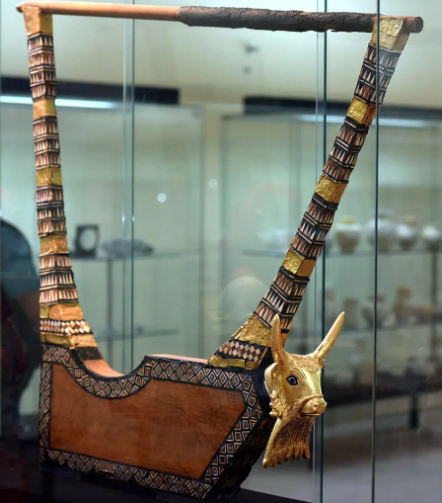
The image shows the lyre found in Ur from about 500 years before the time of David. It's a silver lyre with a bulls head, which represents the Age of the Bull (Aries). All that remained at the time of discovery were the silver columns and non-perishable parts. Until the 1800's, strings were made of animal guts. The body of the bull was the sound box where the gut strings ran from the box to the cross bar at the top. Like modern tuning, one string was tuned first and that determined the pitches of all the other strings. This was how concert pitch is set, even in Sumerian times!
Richard Dumbrill is an ethnomusicologist at the British Museum. We had a couple conversations via email. In one of those emails, he sent me his highly technical research paper on the Lyre of Ur. His paper included how the lyre was tuned, the reconstruction process, its history, etc. Dumbrill also refers to a Sumerian tablet that showed how to tune the instrument. CLICK HERE to visit Dumbrill's YouTube channel where he has a few videos on the reconstruction and tuning process. There is also an ancient Hurrian Hymn that's written on a tablet that Dumbrill plays on the lyre. (That video is on his YouTube channel.) In the end, Dumbrill found the Lyre of Ur was probably tuned around the A=439 concert pitch based on the best string tension needed to create a good tone.
Historical Overview
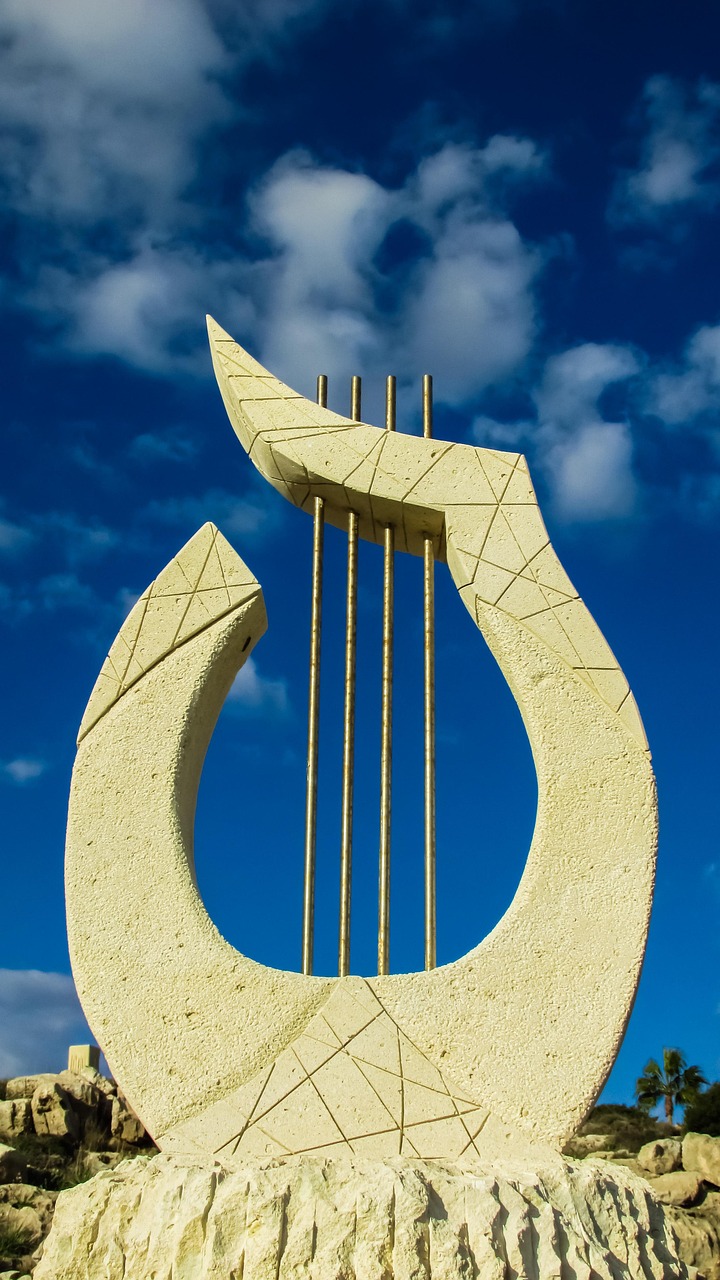
At this time, the only evidence that exists about David's lyre is what's written in the Bible. His instrument isn't described in full detail but if we use the Lyre of Ur as an example, we get a general idea of what David's instrument might have looked like. In addition, there are paintings of lyres (and other musical instruments) all over the walls of ancient Egyptian buildings. We know that the cultures of these countries intermingled through trade and swapping of ideas. Therefore, based on the evidence we do have, the Hebrew people had knowledge of what their neighbors were doing.
To answer my question "Is there a key of David?," we must turn to music theory, harmonics, King David's lifestyle, and what the ancients understood. Musical harmonics (overtones) is a natural law. People follow that law whether they know it or not. Dumbrill found that the Cuneiform tablet demonstrated a tuning process similar to the methods of modern piano tuners using 4ths and 5ths. Ancient tuning was all about musical harmonics, intervals, and what sounded pleasant to the ear. This is evident in the instruments that survived and are in museums across the world.
What we know about tuning prior to the industrial revolution in the 1800's AD:
- Ancient Chinese gong makers used cymatics to choose pitches and tune gongs.
- Cymatics images were used on stone cubes in the Rosslyn Chapel (Scotland) that when translated to musical pitches are a Gregorian chant.
- We see evidence of cymatics on ancient Egyptian wall paintings.
- It's highly plausible (based on the above) that Cymatics was an early form of musical pitch identification. The shape of resonating sand or powder on an object determined the musical pitch. Ancients knew the pitch by the shape it produced, not by its sound.
- Before tuning forks, musicians used the town bell, or something else with a fixed pitch (a piece of metal, stone, etc.) to tune instruments.
- There is no physical evidence showing how David tuned his lyre nor was there a specific lyre tuning protocol at that time other than what's on the Sumerian tablet (mentioned above).
- Pitches and tuning were based on personal choice until the 1800's. A.D. The modern standard (A=440) was set in 1939.
- The Bible never mentions HOW David tuned his instrument.
I'd like to propose here that the "key of David" isn't a musical key. What is the definition of a key? First of all, keys unlock doors. Other words that are used to describe a key include gateway, secret, ticket, passport, method, means, blueprint, strategy, and access according to Merriam-Webster Thesaurus.
What is the Key of David?
When I think of the phrase "key of David," I wonder what he was unlocking and accessing that others didn't know how to do? We see that his playing soothed King Saul when he would go into raving fits. What type of music does that!? David also played and sung in the fields while tending his flocks according to scripture. We read about those songs in the book of Psalms as a "song of David." However, none of it tells us his tuning or note choosing process. For that, we look at historical artifacts and musical practices around the time of David to make some plausible assumptions.
We know the natural laws of music (harmonics) were evident in tuning practices of the ancients and that melodies were similar to what we hear today across the world with slight differences in the distance between pitches (temperament) and the scales/modes utilized in creating melody and harmony. With all of the above information put together...
I propose that the "Key of David" is worship
David's worship is a key that unlocked doors that then gave him access to a higher realm of understanding. How else do you think King Saul's soul was soothed? It's more than the music alone. How can I say that? It's no different than the music of today. People choose music based on the mood they're in or the intention they want to "come into agreement with" (entrain) through music. This is how the healing music scene of the 21st century began - with an understanding that intention is a HUGE part of the process, especially when paired with calming music. It seems obvious that David understood the power of intention and worship.
The key of David isn't a musical key - it's the key of worship!
David didn't have our modern tuning devices and would have used his intuition while following the natural laws of music to tune his lyre. There was a dimensional shift in consciousness as he worshipped that created an atmosphere of healing for Saul. David's worship also unlocked mysteries for many amazing supernatural things (beyond human understanding) to occur.
When we think of musical keys, we think literally. In exploring other definitions, it's easy to see how we could be led to think the word "key" only refers to a musical key. It's obvious by reading scripture that David had an intimate relationship with Yahweh and that led to his many exploits as King. The Egyptians wrote about the Hebrews (calling them Semites at first) and eventually the nation of Israel shows up in various Egyptian writings, especially on stone Stelae (which often spoke of the countries Egypt conquered).
As far as identitying which concert pitch or musical key David used to play, there's zero credible evidence to lead us in a plausible direction for specific notes or even a concert pitch. Artifacts discovered from David's historical time period are all we can currently use to make any assessment. That may change as more artifacts are found. Based on ancient history, David would have used his intuitive senses to tune his lyre probably using a system that resembles how the Lyre of Ur was tuned (4ths and 5ths). Through pure worship of Yahweh, the "frequency" of his intention was delivered to the recipient. Thus, healing music may have been "invented" by King David!
From a position of worship, all one has to do is read the Book of Psalms to read the songs of David. When you pair intent with the music, it creates the energy need for something to happen. It's like a positive and negative terminal create an electrical current. In David's case, his worship was creative. It was filled with intention where he glorified Yahweh, probably killed a few wild animals that went after his flocks, and soother the savage beast in Saul's soul. It's amazing what worship can do when paired with godly intention.
Conclusion
Based on what we know about David's worship, it's important to pay attention to the words sung during our times of worship. Words add laced with intent! To interact with the Key of David, put the focus on God, not ourselves. We choose the words of our songs carefully. In a sense, the NW Ekklesia worship team has done this without even realizing it. We don't sing standard worship songs unless they just come up or someone in the group feels led to sing a specific song. Led by the Mystic Frequency Collaborative (members and friends of NW Ekklesia), the group follows a style similar to what we think David did.
From the website, it says "Our music flows from a mystical point of view in that we create [or worship] while 'in the spirit.' We engage with all of creation during the process and explore what that sounds like through the use of vocals, a variety of percussion instruments, keyboard, guitar, and some very unconventional instruments as well. What does it sound like in heaven and the cosmos? We bring what we see, hear, sense and feel from a heavenly perspective into the music -music that often tells a story."
When you attend NW Ekklesia "gatherings," you'll find members of the Mystic Frequency Collaborative leading worship sets as they sit in the heart of the Father. From there, we engage with pure worship (honor, adoration, etc.) and then let the music flow. Sometimes there's singing but a lot of times, there's no singing. Sometimes we break into spontaneous drum circles or meditation. People use flags and can often join in with the worship using a variety of percussion instruments. We're not a traditional worship team and desire to go where God wants to take us. We believe this is the key of David.
Shalom!
Del