
by Del Hungerford and Paulette Rahm
NW Ekklesia is different from many churches in that we enjoy bouncing ideas off one another as we listen to a variety of teachings rather than listening to one preacher/teacher as our main source of information. No one person or organization has the full picture of what God is doing so it requires listening to many voices and pulling out the nuggets and finding out how each nugget fits within the overall puzzle of Kingdom living. Of course, it’s important to compare what we hear to the Word of God, making sure our research lines up with God’s character.
A recent example is when Del and Paulette worked together while listening to a teaching by Nicolas Acuna.
Secrets House of Light PT 1. There are three teachings in the set and can all be found on Nicolas’ YouTube channel – Mystical Futurist. In this article, we’ll discuss our thoughts on the first video (Part 1).
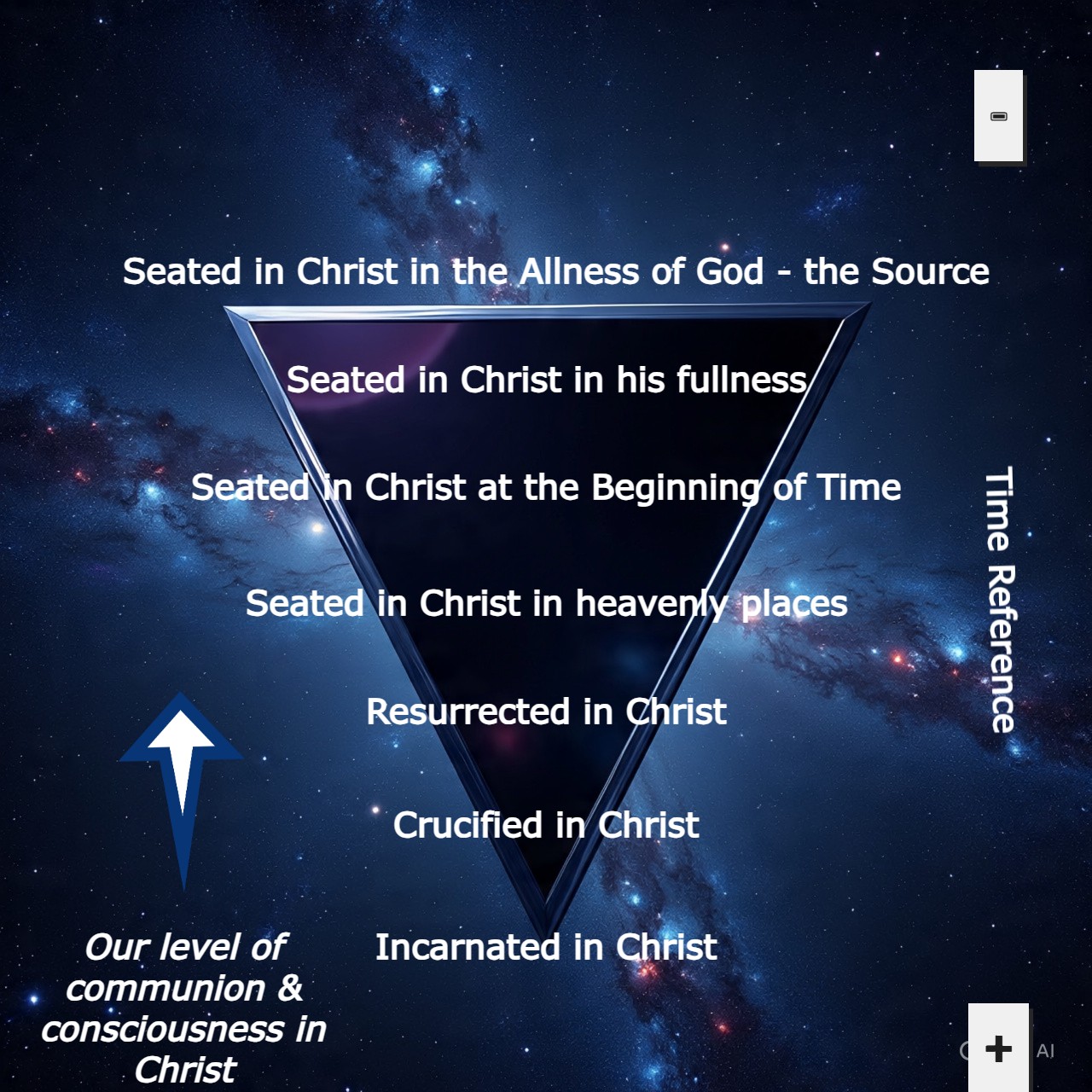
Figure 1
As the two of us (Del and Paulette) went through Nicolas’ teaching and Ian’s prayer line by line, we received deeper revelation and understanding of truths that were there all along. Ian and Nicolas both talk about our “light being” and how our bodies need to remember who we were at the beginning of time.
We know that we’re spirit beings, but we also have a soul and physical body. That’s two-thirds of our being that doesn’t remember who we were “at the beginning!” You'll see that "progression" in Figure 1.
The key is to see that as we mature, we “ascend” into higher levels of consciousness and communion where we not only sit with Christ in heavenly places, but we govern as co-laborers and co-creators with Christ. Nicolas mentions the seven levels of communion from another teaching on an upside-down triangle. We created our own version of that chart in Figure 1. We’ll add to it for the communion prayer activation at the end of this article.
Terminology
Let’s begin with some terms that explain both Ian’s communion prayer and Nicolas’ reference to communion as well. First and foremost, when we take the blood of Jesus and the bread (Christ’s body) in communion, we identify with His DNA. We combine who we are with who He is. As we fully understand that we’re seated in Christ in heavenly place (Ephesians 2:6), we rise above earthly circumstances. Nicolas uses the term “Christo-kaic” in his teaching andsays it is the highest level of communion. Nicolas says that our Christo-kaic light body is the one that grows in the likeness of Christ. A Christo-kaic “structure” is infused with light (the glory) where light and life create shape. This can only be done in the spirit – not the soul or body. We actually have three "bodies" according to Nicolas - spirit body, soul body, and physical body. It's our "spirit body" that becomes the Christo-kaic structure.
What is coherence? Similar words include – symmetry, harmony, balance, coordination, order, and unity. In a nutshell, our spirit, soul, and body must come together in harmony to coordinate as one unit in perfect symmetry and balance. That can’t happen if the mind is in a different place than the heart. This is why the Word says to renew the mind and put on the mind of Christ. When we resonate with the “Allness” (likeness and image) of God, our entire being (spirit, soul, and body) aligns with that truth. It’s a process that continues through our lives as we move from the born-again experience, where we’re “incarnated” with Christ, up through various levels of maturity in communion and consciousness of who God is and who we are IN Christ.
Incarnated, according to Mirriam-Webster means “to make incarnate: such as (a) to give bodily form and substance to (example: incarnates the devil as a serpent) or (b) to give a concrete or actual form: to actualize.” When Christ came to earth, he was fully man (physical body) and fully God (spirit body). This is how he could just disappear through crowds, do amazing miracles, know about the future, create something out of nothing, etc. When we’re IN Christ, we should be able to do the same things He did. Take a moment to ponder on that truth… Jesus even tells us we’ll do greater things than He did! (John 14:12-14). Communion is the “vehicle” that brings us into coherence with the DNA and Allness of God. Remember that the “born-again” experience is the beginning stage of our spiritual “birth” and from there, we move up to higher levels of communion and consciousness (awareness) where we identify with the crucified Christ.
Nicolas states that the crucified Christ identifies the pain He suffered (level 2 in Figure 1). However, if all we ever do is identify with Christ’s pain, then we never get over the pain in our own lives (both emotionally and physically). We must go higher into communion with greater maturity and understanding of God’s character, which is a deeper level of consciousness and awareness of God’s truths. What does that mean? Consciousness is being in an “awareness” state. Some synonyms that may help explain it include understanding, knowledge, discernment, hyperawareness, and cognizance. We have both unconsciousness and subconsciousness to consider. What’s in our subconsciousness comes from the things we’ve “rehearsed” in our thoughts, words, and actions throughout our lives. When we step into God’s thoughts, we become “God conscious.” That’s the ultimate goal which requires letting go of our personal biases and preconceived ideas. That takes time and practice!
As we continue moving up the levels of communion and consciousness, we must identify with the resurrected Christ (level 3 in Figure 1) as described in Romans 6:4-6. These verses include the death, burial, and resurrection of Christ. These are the 1st through 3rd levels on our communion journey. To get to a higher level of consciousness, we must fully understand that our “old self” was crucified with Christ, we’re resurrected with Him, and we live in His glory where we’re free from all types of pain. We are above the trauma and drama of life and put our eyes toward the “things above.” We can’t be a victim in the resurrected Christ because that was taken care of on the cross. This is why resurrection (level 3) is one level higher than the crucifixion (level 2).
Ephesians 2:6 says that we’re seated with Christ in heavenly places, which is the next level of consciousness and communion (level 4). What does that actually mean? Imagine you’re at a huge banquet table with the president or king/queen of a country. That’s a pretty special place! You must be invited and have achieved something to be at that table! In this level, there’s deeper conversation, knowledge, understanding, wisdom, and authority that comes with a position. We step into that position as we renew our minds by putting on the mind of Christ. The more we live from that position, the better our communion is at this level of consciousness.
As we’re seated in Christ in heavenly positions, what goes on in the world shouldn’t negatively affect us because we’re learning to deal with negative triggers from a higher position – in heavenly places. This is where the phrase “as above – so below” comes from. It’s from this seated position IN Christ that we rule and reign as Sons of God. We bring the revelation of heaven into the earth and release those truths to all those around us. Our “in Himness” should affect those around us. To the degree it does or doesn’t, depends on how much and often we function at the "seated in Christ" level.
We can go to an even deeper level of consciousness and communion IN Christ that speaks to our identity (level 5). If we’re confused about who we are, we can’t “reside” at level five. At this time in history, there seems to be a major effort by the enemy to confuse people about their identity. If we can get sidetracked from understanding who we were created to be, then we can’t even live at the level of the resurrected Christ because we’re too focused on the cares of this life and the traumas we’ve experienced. To function at level five as spoken of in Ephesians 1:4, we must understand WHO we were created to be at the very beginning of time! However, it requires putting on the mind of Christ in level four so we CAN understand more about our identity as we renew our minds.
Level six is all about our part as “co-creators” in Christ as spoken in Genesis 1:26-28. In the Message Bible, it says, “Let us make human beings in our image, make them reflecting our nature…” OK, if we’re going to “reflect the nature” of something, in this case… God, you’re in His likeness and His image. The next thing God tells man to do is name everything. In Hebraic thinking, when you name something, it’s creating that thing. Therefore, Adam and Eve were co-creators with God, which means that we are, too. The key to living at this level of consciousness and communion is to understand and function IN CHRIST in our identity so we can learn to co-create. But to do that efficiently, we must go to the next level – join our thoughts with God’s thoughts. This is where we think and act like Him.
This is more than putting on the mind of Christ, which Nicolas points out in his teaching. We take the thoughts of God into our light body where we reside and function in glory as we’re seated IN Christ. Sue Beckman, also a member of the NW Ekklesia council, coined this as “We’ve joined God’s business – God and Sons.” We become CEO’s in our light bodies where we function in our personal and specialized identity where we then put our individual creative stamp of facilitating “as above – so below.”
Nicolas Acuna Teaching
Nicolas presents great information in his teaching that explains communion and how it affects us. I believe he goes more into communion in Part 2 where he discusses mitochondria. It’s important to watch Part 1 before going onto Part 2. We recommend that you open the YouTube transcript so it’s scrolling next to the video. Stop/start the video so you can either copy/paste what’s in the transcript or write it out (by hand). NEWSFLASH! Scientists, teachers, and other academics have noted in various studies that handwriting helps with comprehension. This is one reason it’s good to have a journal.
In the beginning of Part 1, Nicolas presents the seven levels of consciousness and communion starting from the physical body and moving upward to the heavenlies. As mentioned above, we changed some of the wording to make it clearer and made a similar image to Nicolas' in Figure 1.We have three bodies: physical body, soul body, and spirit body. The spirit body is our “light” body where we fully reside in the glory of God. To function in that level, we must come into coherence where the heart and brain agree with the thoughts of God and the mind of Christ. Trauma and chaos are abolished in the glory. Nothing negative can exist on that “plane” of consciousness.
We’ve taken the seven points presented by Nicolas from Figure 1 and rephrased them to include I AM statements in Figure 2, which we’ve also added into our new communion prayer. As we declare daily over ourselves, eventually our spirit, soul, and body come into coherence with the thoughts, likeness, and image of God as we reside in the mind of Christ and thoughts of God.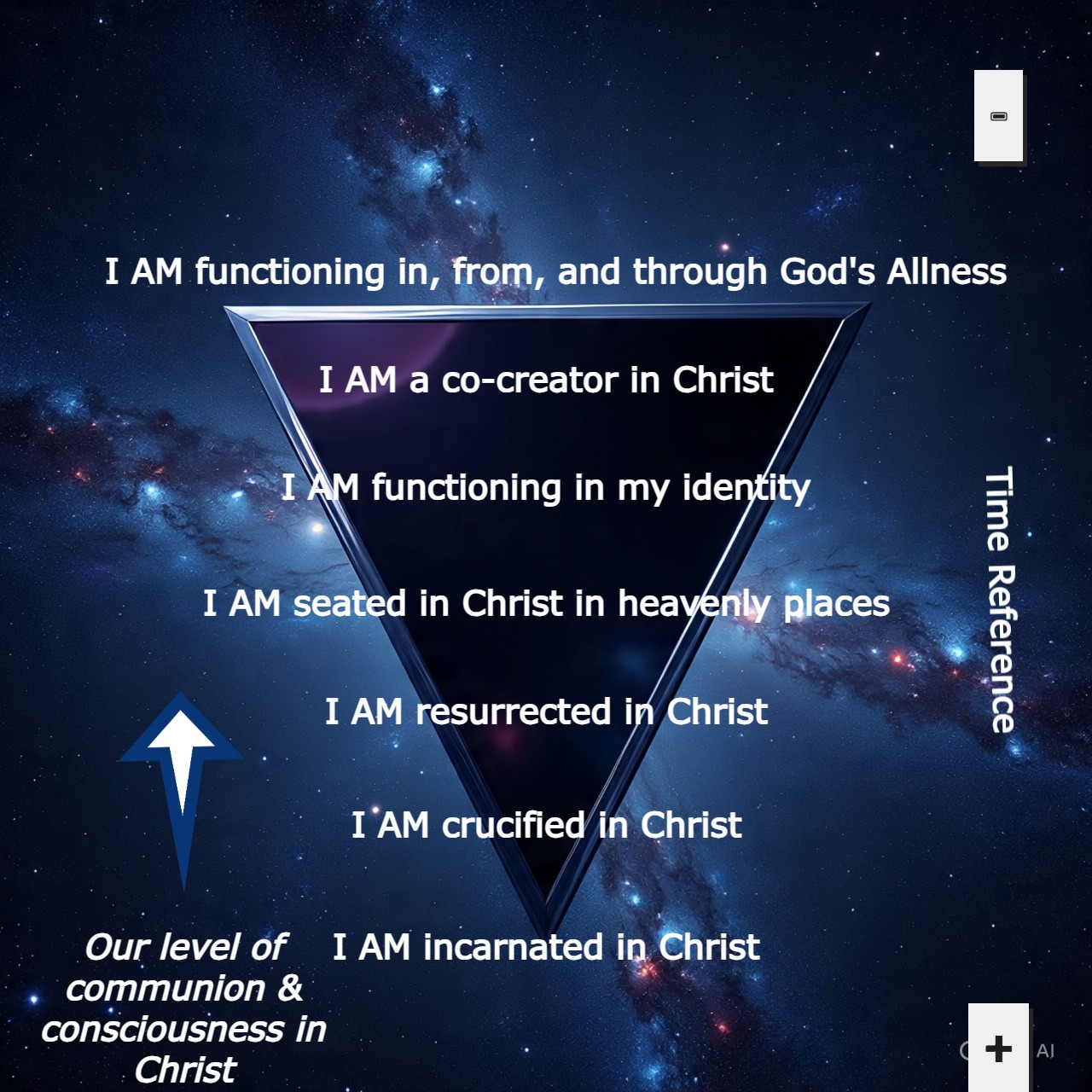
Figure 2
Here are the I AM statements with their scriptures listed in order from bottom (lowest level of consciousness and communion) to the top (highest level of consciousness and communion):
- I am incarnated in Christ (John 3:16)
- I am crucified in Christ (Galatians 2:20)
- I am resurrected in Christ (Romans 6:4-6)
- I am seated in Christ in heavenly places (Ephesians 2:6)
- I am functioning in my identity from the foundations of the world. (Ephesians 1:4)
- I am a co-creator in Christ. (Genesis 1:26-28)
- I am functioning in, from, and through the Allness (image and likeness) of God. (Genesis 1:26)
A principal scripture for understanding “light” is John 8:12 where it says that Jesus is the light of the world. The light of life (the agent of all consciousness) transmutes (converts, transfigures, changes, etc.) to the glory of the Lord. Our likeness in Christ brings revelation from heaven to earth so “matter” (material things of this world) manifests. We are the connection between heaven to earth as co-creators as we’re seated IN Christ in heavenly places where we function in our identity with the thoughts of God and the mind of Christ.
Understanding the Communion Prayer
Going back to the communion prayer, the transfiguration on the mountain occurred before Jesus was resurrected. We know he already functioned in his light body because he would disappear before people’s eyes and could do things no human we've ever known does. Why do you think that is? Obviously, something about him was different. When you read the account of the transfiguration on the mountain in all four gospels, make special note of HOW he looked. This was a precursor to his light body after the resurrection. When we take communion as the light being we’re supposed to be, we step into greater revelation of who we are IN CHRIST. The more we take communion, the more our entire being begins to resonate with the energetical system of the light body we were before we came to earth. From our light body, we bring the heavenly revelation into the rest of our body (soul body and physical body).
Obviously, Jesus was all God and all man because he’s one of the few who somehow remembered his calling on life and understood the kingdom of heaven at a greater level better than most of the Jewish leaders. This was evident in his childhood, too. Del does an activation (link is at the end of this article) based on Nicolas' meditation that he does in Part 1 of his three-teaching set. As a reminder, HERE is the link to see all three videos. Del's activation is meant to incorporate the spirit body with the soul body and physical body so they function as one as you're seated IN Christ, have the mind of Christ, and live in God's thoughts.
We’ll delve deeper into Part 2 of Nicolas’ teaching in another article. Meanwhile, if you’re reading this on the website, feel free to copy this prayer and begin to say it daily during your meals. If you’ve purchased the activation, you'll have some of this article as a PDF😊Communion Prayer
- I am incarnated in Christ (John 3:16)
- I am crucified in Christ (Galatians 2:20)
- I am resurrected in Christ (Romans 6:4-6)
- I am seated in Christ in heavenly places (Ephesians 2:6)
- I am functioning in my identity from the foundations of the world. (Ephesians 1:4)
- I am a co-creator in Christ. (Genesis 1:26-28)
- I am functioning in, from, and through the Allness (image and likeness) of God. (Genesis 1:26)
By faith, I receive the provision of the law and testimony of your Word that says, I will live and not die, I walk in divine health, putting on eternal life and immortality as declared in Your Word. (1 Cor. 15:53-54)
I engage the record of Jesus’ transfiguration on the mountain that’s in the communion I’m taking. (Matt 17:1-2) It changes the reflection of the kingdom that I live in. I speak to my spirit, soul, and physical body, “Hear the voice of God speak light into you. You are a light body!”
I take communion with my light body – my energetical system. I grow my Christ-like (Christo-Kaic) body as it mediates between the seven levels of consciousness and communion. I receive the blessings of the light body that emanates from the order of Melchizedek.
My light body (glory) releases and receives continual revelation of consciousness and communion as I am transformed into the image and likeness of God.Activation Time!
Del created a voice-over activation to original music so you can engage with this communion prayer daily. When she first heard Ian’s teaching, she recorded herself speaking declarations, prayers, and even Ian Clayton’s communion prayer.
In Del’s words… “I’d turn them on in my truck as I drove to work every day so I could engage in the truths I was speaking over myself. After about two years of doing this daily, I was healed of a 19-year illness. That only came through a process of transforming some stinking thinking where communion was a huge part of it!” The scriptures are not in the voice-over prayer so copy them from this post into your journal. As you begin to receive revelation, write what you see, hear, sense, and feel.
There are two separate activations:
- Communion Prayer: The prayer is spoken over original music (MP3 format) where you repeat the prayer after Del. A recording of the instrumental music (without the activation) is included in MP3 format. There’s a PDF copy of this article, too. PRICE: $10
- Light Body Activation: In Part 1 of Nicolas’ teaching, he walks the viewer through a meditation to activate the light body. Del created an original song (about 30 minutes long) where she does an in depth meditation voice-over activation to original music. In addition, the music alone with the full PDF of the activation is included. PRICE: $15
The Communion prayer is listed above. Feel free to copy it, screenshot it, or whatever works best for you. The key is to take communion daily. If you want to say the prayer (or some version of it on your own), feel free to do so. If you want some assistance, grab the materials provided by Del.
Happy Practicing!
Del and Paulette


 Let’s take this scripture and reword it a little and see if that changes the meaning. Here’s the original in the NIV: “Heal the sick, raise the dead, cleanse those who have leprosy, drive out demons. Freely you have received; freely give.” Now, let’s replace the words freely, receive and give with another translation that might explain the scripture a bit better. “Heal the sick, raise the dead, cleanse those who have leprosy, drive out demons. Undeservedly you have laid hold of; undeservedly deliver.” There is nothing in any of the above definitions that points toward receiving pay for services rendered. There is no hint of that anywhere! On the other hand, when looking at the scriptures in the first paragraph, there is clear evidence that a workman is truly worthy of his hire. Bottom line, when people provide a service, pay them what they’re worth. If you don’t agree, go somewhere else.