
Church Age vs the Kingdom Age

by Del Hungerford

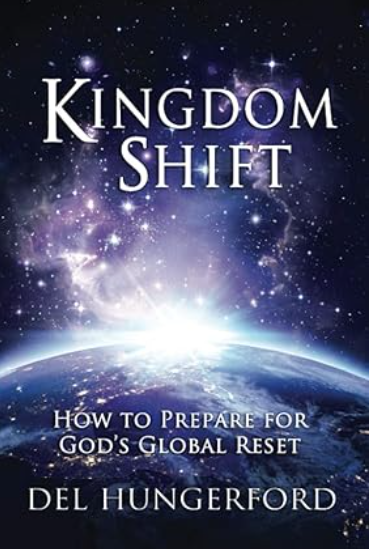
In 2020, I had an encounter with the Lord that lasted a full month. Intermixed with my teaching duties and other life happenings, it was like I lived in this place for the entire month of October, 2020. When it was all over, a book came out of it – Kingdom Shift: How to Prepare for God’s Global Reset. In the encounter, I was taken to an ancient document room in heaven where Yahweh put blank pieces of paper in front of me with titles on them. I was then instructed to go and research the information in the titles. I knew this information had to do with a global reset of sorts. And, this was before world governments began to talk about their version of a global reset. I knew I was onto something.

Here is a quick synopsis of that encounter with Yahweh in the document room in the heavenlies…

As I enter the room, I focus on the many books skillfully placed on the shelves in an ancient document section of a library in heaven. Many are bound with animal skins. Some appear thrown together with string-like threads connecting the pages. Others are simply rolled up scrolls written on parchment and animal hide. There are even cuneiform tablets, pictographs on slabs, and important writings on cave walls that were transferred to a recording device for storage in this room. I did not expect answers to my current event questions to be in this room.


In my spirit, as I peruse the books, I hear that books can be written on people’s hearts. When people die and go to heaven, books in their hearts are finally written and are now in this room. In the center of the room is a giant oval-shaped wood table that can seat about twenty. Strewn across the top of the table are piles of paperwork waiting for me to sort. Yahweh sits across the table from me, pointing out key pages to investigate. At the top of each page is a title that describes the contents of the document. (Chapter 1)

By the end of this month-long encounter, I had taken a list of titles on blank pieces of paper, researched the topics, and wrote the book. The key was to see HOW God was moving from our current “age” into what’s coming next. At the time of Jesus, they were moving from the age of Aries (bull symbol) to the age of Pisces (fish symbol). We now call it the “church age.” This is one reason the church adopted the fish symbol as a representation for Christianity. As we transition from the age of Pisces to Aquarius (water symbol), we must ask the same questions about what’s next. Many now coin this next age as the “Kingdom Age.” We are leaving the church age and entering a higher conscious level of functioning. How will that look? To get an idea, we revisit the transition from Aries to Pisces to gather clues. What will Christianity look like as we move into a new age?

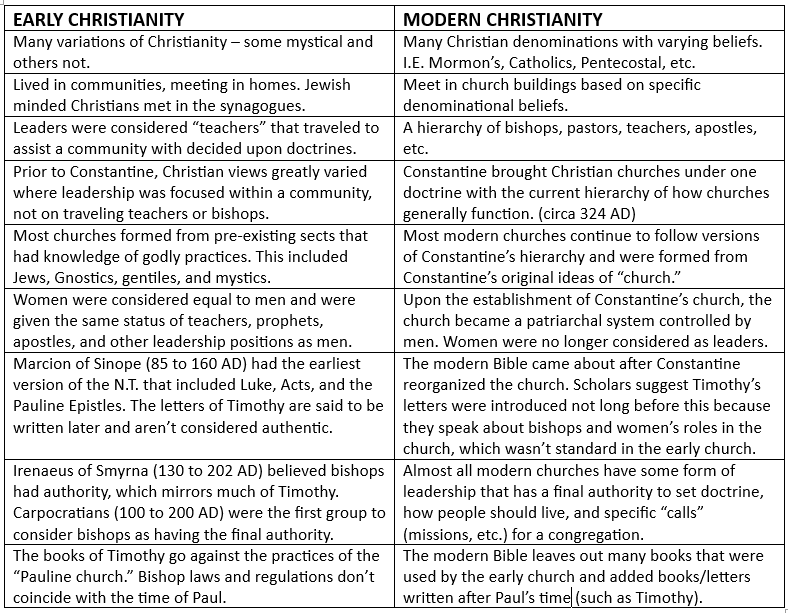
The "great year" is a 25,000 year cycle that changes "ages" about every 2,000 years. Transitions from age to age are consistently filled with similar instances such as civil unrest, great advances in philosophy, political unrest, amazing artistic endeavors, scientific discoveries, religious transitions, advances of all types, natural disasters, pandemics, and much more. What’s happening in the 2000’s mirrors what occurred in Jesus’ time but with a modern twist. What can we learn from a previous age shift to prepare us for what’s coming next? The chart below compares the early church with the modern church based on the documentary and early church writings mentioned in the sources at the end of this article.

Where does this leave us in 2024? 

We can see from the comparison in the above chart that the way Paul structured the church is not the way the modern church functions. The "Pauline" church is the earliest form of Christianity. Why did it change from Paul's established protocols? Why was there a need to create a central church? Why did women lose the ability to be leaders? Why did Constantine take some books (letters to churches) out of his new Bible while adding others that weren't considered part of the original teachings? There are many speculations as to why this is the case. In order to answer any question best, we must look at human behavior for answers. A good question to start with is "who wanted the control?" 

In Moses’ time, God wanted to meet with the people as a whole. Yahweh invited everyone to go up the mountain with Moses. The people were afraid and told Moses to go for them. Meanwhile, they created the golden calf to worship because Moses was gone too long. They had a desire for someone else to teach them how to have a relationship with God. Fear kept them from understanding what God truly had for them. My guess is this is one reason they wandered in the wilderness for 40 years. It's obvious from the behavior of the Israelites over time that they preferred to have a leader tell them what they needed to know. Remember, they'd been under a pharoah for 400 years so that's what they understood! The behavior exhibited by the Israelites does seem to fit human nature based on historical evidence in most cultures.  

Yahweh’s desire is that everyone have a personal relationship with Him. This is the reason Jesus died on the cross. His death created a bridge we could cross for direct access to Yahweh, just like He had with Adam and Eve before the fall. No longer did the priests need to sacrifice animals in a temple for the atonement of sins. What would have transpired had the entire group of Israelites gone up the mountain with Moses? Would we have the Ten Commandments as we know them today or would they have looked different? How would the priests function in the temple had everyone agreed to meet with God on the mountain? Would the Israelites have made it to the promised land much sooner? 

Mankind strongly desires leaders, including religious leaders (and gods). The reasons for this vary depending on cultures. It does appear by looking at all the statues of gods throughout history, a need for a visual god might be due to our desire for God to be tangible. God didn’t want His people to have kings and gave them judges instead, of which one was a woman (Debra). Eventually, Saul was anointed king by the prophet Samuel after the Israelites pestered God for a king. From that point forward, Israel struggled. We find the situation to be similar to any current king, prime minister, or president in modern society. We can’t imagine what it would be like to function without these leaders because it’s all we’ve known. Similarly, we can’t imagine what it’s like to function without the structure of the modern church because we've never experienced a different way. In order to step into the Christianity of the Kingdom Age, it's going to require a shift in mindsets with an understanding that the Kingdom Age could be quite different than the Church Age.  

Looking back at the Pauline church, we see a family or group setting where everyone contributed equally. I’m guessing that people who didn’t want to pull their weight were uninvited from those communities. There was probably no sense of entitlement within well functioning groups. Entitlement comes when we want others to do for us that we should do ourselves. In Paul's time, it appears many pre-established communities morphed into something new once Christianity came on the scene. As the apostles traveled through various regions, they met with these communities to establish Christian basics and to help them correct doctrinal errors. 

Because these communities were often pre-established, it seems natural to assume the apostles arranged to visit, preached the gospel, and won them over to Christ. History shows "many were added to the faith daily." Therefore, it's not too much of a stretch to see how existing belief systems might have been a foundation for believing the gospel of Christ. These groups had some pre-established godly ideas that helped multiply Christian concepts. Consider what it would be like taking completely new concepts and letting people sink or swim with no previous knowledge of the ideas. For example, we couldn't possibly understand flying a group of people to the moon, dropping them off, and saying “now, go live your life.” They would have no previous knowledge of how to function in that setting and might not be able to survive. It only makes sense that Christianity spread quickly because many pre-existing groups (as suggested in the documentary) were already on a godly path even if some of their beliefs weren't Christian. 

I suspect a sense of taking what's known and shifting focus will continue as we move into the Kingdom Age. I envision the modern "church" acting as a bridge where people learn to understand Christian ideals and then begin to transition into something we don't yet know what it will look like. Some will stay on the church bridge to help newbies while those ready for more may fly over the bridge because they're primed for what's coming. I liken this process to the twelve grades in school. There are teachers at different levels to help students transition from one grade to the next. The church age is like high school where we learn basic doctrine and how to function as a Christian. For many people, this is as far as they want to go, which is fine. Those who want more will continue their "education" in "Kingdom School."

"Kingdom School" begins beyond the high school (church age) level, which is where I believe we're heading as the primary manner of functioning in the Kingdom Age. Kingdom college is about functioning as Sons of God, adding a deeper understanding of the supernatural realms and diving deeper into the mysteries of God through relationship WITH God in a way many are now experiencing. As a SPIRIT, soul, and body, we must learn to function equally in all "dimensions" of our being. We can't live totally by what we physically see, hear, sense, and feel. Even quantum physics says we live in a hologram! The Kingdom Age is about adding things "beyond what we see." Some call this the mystical realm, which has been prevalent throughout history. Many "mystics" were God-fearing men and women who believed and practiced what quantum physics is now discovering. The point here is many people understand there's more to being a Christian than what our physical senses tell us. It's about relationship with the One who created us so we partner in the creation process with Him. 

There has to be people at all grade levels of Kingdom School to help with the various transitions from Pisces to Aqurius. As we mature, we become partners in the business, "God and Sons" while studying in the graduate degrees of heaven. I discuss how this works in the Maturing as a Mystic (book) and Maturing as a Mystic: Workbook. To read about the books and order them in paperback or Kindle, click on the titles.

God is Loving and gently guides us through any transformation process. As we enter the Age of Aquarius, I suspect that the modern church will act as a “bridge” that leads us into the Kingdom Age but once we get there, it’s going to be very different than how we're used to seeing the church function. It seems Paul understood the direction of the church (ekklesia), but man’s desire for bishops and pastors changed the course because the responsibility for leadership was taken from the people and put on these revered men. 

This decision put us back under Old Testament law. That's obvious by looking at the Catholic church where sins are forgiven only by a priest during "confession." In order for us to function as we were intended, it seems we must first disengage from the laws set up by the Constantinian church.  

Holy Order

I must first mention here that order is needed. Just like a military, there must be some form of "rank and file." However, this comes with responsibility from people at all ranks and levels. No one person or level is more important than the other because an organization can't function well unless everyone at the various levels is doing their part. Based on my 50+ years of being in the church, major adjustments are needed in our paradigm of order so we're prepared for what's coming during the age transition. The modern church has put too much empahsis on single leaders as our "savior." When those leaders go through "moral challenges," it often destroys an entire congregation or movement like we saw in the 1980's and 1990's. Had those organizations been under sound "order" to begin with, there would have been less "fall out." Why did this happen? People worshiped the minister, not God.  

How does God want relationship with us? Jesus’s death triggered an earthquake where the veil in the temple ripped, exposing the Holy of Holies to those other than priests. This act allowed mankind direct communication with God which meant we don’t need priests or bishops to tell us how to act and live. We can meet personally with God on our own. However, we need community to provide checks and balances to keep us focused, which was the Pauline way. A church “covering” is the community at large where we honor one another equally with the gifts within each of us so we function as the “body” of Christ. Our "protection" is within a community that know each other, not necessarily a prophet, apostle, bishop, or pastor that we don't have personal relationship with. This is evidenced in how Paul and the other apostles set up the "churches" that were run by both men and women within the community, many holding positions of leadership to assist with the needed checks and balances. 

Based on history, once the Age of Aquarius is fully established, I suspect what we know as "church" will transform into something new as everyone steps into a deeper personal relationship with God where we co-create with Him. If we don't learn to transition, we'll go around the mountain again, just like the early church did when Constantine basically set us back into Old Testament law. How a transition looks, only time will tell as communities come together without relying on a single leader directing spiritual traffic. 

We must become responsible for our own spiritual health and question what's taught by discovering what's true from what's hype or false. We must honor leaders without worshiping them. We know we're worshiping someone when we do what they say no matter what. In a sense, they become our conscience. Those who worship pastors or bishops will do anything to get on the good side of those people. When told to "jump!" man pleasers respond, "how high?" We were given the ability to think and process through what's been presented so we don't become brainwashed. How else do you think the German people were completely indoctrinated into the ideals of Hitler in less than ten years? They blindly accepted and believed everything the German government told them. Cults are formed when people follow leaders without questioning the ideals. Reason with one another to find truth and "spit out" what doesn't line up with God's character. 

When God invited the Israelites to, “come to my mountain as a people,” they had an opportunity to establish a new precendent as a community. They chose one person to lead them rather than going to the mountain of God as a group, which cost them personal relationship with their Source. Nearly 3,000 years later, we have that same opportunity to do what the Israelites chose not to do. We're at a transition point, which is the perfect opportunity to assess where we want to be. Will we live by fear as we move from one age to the next or will we step into a Perfect Love that feeds our faith that then catapults us into how we’re to function as Sons of God in this new age?

Be sure to take some time to peruse through the sources for this post. As we all should, it's our responsibility to look at what's presented to us and discover our own answers rather than believe everything we hear or read. I've added key points from the sources in this article to create a sense of curiosity within you for further study. You decide what to do, how to think, and how to act. Your very life depends on it! As we mature into Sonship, we govern our own lives within a community of believers to help keep us in balance. We're responsible for doing the work rather than relying on a preacher to dictate what we're to believe. If we don't question what we're being taught, we'll never fully understand a truth. Many sources (below) are mixed with non-Christian beliefs but adhere to Christian ideals. What the materials point to is HOW the early church functioned and what beliefs led to what we know as the church today. 

Del, June 2024

Sources

The third source (below) will take a very long time to go through but appears to be a complete list of accepted scholarly materials written and available at the time of the early church, including Gnostic sources. It's important to understand the mindset of those living at the time of Jesus to grasp how the church was established to begin with. Therefore, many of the writings are from non-Christian sources but do provide an historical perspective. Happy researching!

A Workman Is Worthy of His Hire

by Del Hungerford

There are several scriptures that relate to the phrase “a workman is worthy of his hire.” To name a few: Luke 10:7, 1 Timothy 5:18, Mathew 10:10, Leviticus 19:13, and Deuteronomy 24:15. CLICK HERE to read those scriptures in Bible Gateway.  Consider looking at each scripture in a variety of translations. Depending on your religious paradigm, the interpretations will vary.

Here’s the issue with our standard belief system concerning people getting paid, specifically to “minister.” For some odd reason, we seem to have it in our minds that since “freely you’ve received – freely give.” This scripture comes from Matthew 10:18. CLICK HERE to read a variety of translations in Bible Hub. I encourage you to read those translations before looking at the definitions below. Once you’ve done that, look at the original Greek in Bible Wheel. CLICK HERE for that information. Here is a synopsis of those definitions.

  • FREELY: δωρεαν dorean {do-reh-an’} without a cause, in vain, for nought, freely, undeservedly
  • RECEIVED: λαμβανω lambano {lam-ban’-o} receive, take, have, catch. To take, to take with the hand, lay hold of, any person or thing in order to use it, to take up a thing to be carried, to take upon one’s self, to take in order to carry away. Without the notion of violence, i,e to remove, take away. To take what is one’s own, to take to one’s self, to make one’s own. To claim, procure, for one’s self. To associate with one’s self as companion, attendant – of that which when taken is not let go, to seize, to lay hold of, apprehend. To take by craft (our catch, used of hunters, fisherman, etc.), to circumvent one by fraud. To take to one’s self, lay hold upon, take possession of, i.e. to appropriate to one’s self. Catch at, reach after, strive to obtain. To take a thing due, to collect, gather (tribute). To take, to admit, receive. To receive what is offered, not to refuse or reject. To receive a person, give him access to one’s self. To regard any one’s power, rank, external circumstances, and on that account to do some injustice or neglect something. To take, to choose, select. To take beginning, to prove anything, to make a trial of, to experience. To receive (what is given), to gain, get, obtain, to get back.
  • GIVE: διδωμι didomi {did’-o-mee} grant, put, show, deliver, make. 1) to give 2) to give something to someone of one’s own accord to give one something, to his advantage. To bestow a gift. To grant, give to one asking, let have. To supply, furnish, necessary things. To give over, deliver. To reach out, extend, present. To give over to one’s care, entrust, commit. Something to be administered. To give or commit to some one something to be religiously observed. To give what is due or obligatory, to pay: wages or reward. To furnish, endue. To give, to cause, profuse, give forth from one’s self. To give, hand out lots. To appoint to an office. To cause to come forth, i.e. as the sea, death and Hell are said to give up the dead who have been engulfed or received by them. To give one to someone as his own. As an object of his saving care. To give one to someone, to follow him as a leader and master. To give one to someone to care for his interests. To give one to someone to whom he already belonged, to return 4) to grant or permit one. To commission.

Let’s take this scripture and reword it a little and see if that changes the meaning. Here’s the original in the NIV: “Heal the sick, raise the dead, cleanse those who have leprosy, drive out demons. Freely you have received; freely give.”

Now, let’s replace the words freely, receive and give with another translation that might explain the scripture a bit better. “Heal the sick, raise the dead, cleanse those who have leprosy, drive out demons. Undeservedly you have laid hold of; undeservedly deliver.” There is nothing in any of the above definitions that points toward receiving pay for services rendered. There is no hint of that anywhere! On the other hand, when looking at the scriptures in the first paragraph, there is clear evidence that a workman is truly worthy of his hire. Bottom line, when people provide a service, pay them what they’re worth. If you don’t agree, go somewhere else.

Example time!

With that, we move onto a story. Many reading this know that I’m a musician and create music for the purposes of it being therapeutic. In addition, I create exercises and “practice” opportunities (available HERE and HERE) for those on a journey of Kingdom maturity. As a music creator and teacher, these materials BOTH minister to people AND provide an income for me. In the minds of some, I should be giving out these materials for free. I get that request (only from Christians) on the Healing Frequencies Music website, especially those who really want a particular album but can’t pay for it. In fact, Christians tend to be the cheapest and want something for nothing. The only rude correspondence to date has come from those who say they are Christians – 100% of the time. What does this say about the Christian community as a whole? We've done ourselves no service to the rest of the world when we act like this. 

I see some strange attitudes when it comes to Christian conferences as well. Conferences aren’t cheap to host. People fail to realize that renting a building, purchasing supplies, and paying service providers costs money. There’s this paradigm of “God will provide” so you should just let us in for free. I was at a conference where a group of women all wanted a teaching set. They agreed to pool their resources so they could purchase the whole set (as a download) and share it among themselves. In other words, the woman who purchased it would then send a copy of the downloads to the other women so they’d all have their own copy. I watched this play out for a bit while they discussed it and eventually asked a simple question, “Do you think that’s a good trade?” Long story short… after some further discussion, they decided not to go through with it. How do you feel about their discussion?

When you do a job, you’re providing of form of “ministry” to someone whether it be fixing a vehicle, cutting hair, giving money to the teller at the bank for a deposit, etc. That person is doing something for you that you can’t do yourself. So, he/she is ministering to your needs. To understand more of why I say that, consider reading my article about ministry vs. jobs. You'll find it under the blog posts.

From what I’m reading in Matthew 10:8, it doesn’t direct any meaning toward providing services for free. There aren’t scriptures that seem to point to that interpretation either (unless I’m missing one) but there ARE plenty of scriptures that address being paid what you’re worth. Honestly, I think this concept of providing services for free has only been around for 100 years or so. People think Jesus was poor so Christians should be poor, too. I'm not sure when they received that memo but I don't find scriptural references to support that opinion or mindset. 

The topic of a workman being worthy of his (or her) wages intermingled with the “freely receive, freely give” concept has messed up some people because we tend to swallow what’s preached at us – hook, line, and sinker. We haven’t been responsible for our own spiritual growth because we allow what pastors teach us as “thus sayeth the Lord.” We seem to have no problem paying a pastor… well…  most of the time. They tend to live on next to nothing and have to get a second job in order to make ends meet while we demand their attention to “fix” issues in our lives that we could often fix ourselves by putting at bit of effort into a good solution. This includes Christian counseling, which I had first-hand experience during marriage counseling. What’s the point if we’re not going to do what’s suggested?

Here’s the thing…. when you pay for something, you have ownership in/of it. When you don’t pay, you have zero ownership unless the giver chooses to turn over the ownership to you. A gift is a choice by the giver, not the recipient. 

I was at another conference where one of the speakers kept coming up to the booths saying, “You’ll give me one of those for free?” It was more of a demand than a request. This is all about trading. When you trade, you’re exchanging one thing for another. We can have good trades and bad trades. Much of that depends on our attitude in the midst of the trade. If there’s an expectation that something will be free, that’s a bad trade. Each vendor went ahead and gave this speaker something for free because he kept bugging us. Was that a good trade on his part? I venture to say that it wasn't. 

The Bible also states that we’ll reap what we sow. If we sow bad trades, we’ll reap bad trades. If we have expectations that things will be free because we believe they should be, then we’re not operating with honor or good character. That’s also a bad trade. A good trade involves putting something of value towards what you desire. When you do it that way, you own it. When it comes with an expectation, that’s of no value because it dishonors the giver. Let the giver make the choice to freely give.

Where Does This Lead Us?

We now get back to the main point at the beginning – a workman is worthy of his hire. That’s plain and simple with little room for misinterpretation. When reading the various versions of the Bible on this subject, there does seem to be uniform agreement. That’s not the case with Matthew 10:8. Hmmm…. I find that interesting but will leave that up for your own pondering as to why that is.

The key here is that in order to make a good trade, both the giver and recipient should be on the same page. If you find something overpriced, then don’t moan and whine about it. (There is cheese to go with that whine.) Go find something within your price range that works for you. This includes counseling, receiving services of any kind, attending conferences, etc. If we simply don’t have the funds, then let’s not put it on the giver to lower the price enough that we can have what they’re offering. This might be a growing opportunity for each of us to learn how to exercise our faith muscle and see how God provides.

Why expect someone to meet our needs and desires when we can use a situation as an opportunity to sit with Jesus and discuss His best plan? When we learn to look at our situations through the eyes of Yahweh, we often have a completely different picture of the process and any solutions that go with it. As we learn to move from our personal expectations and paradigms to those of Yahweh, we grow in character. I encourage all those reading this to get outside old religious boxes of expecting things to be free just because of a perception that it’s “ministry related.”

For many of us, what we do replaces a 9 to 5 job. We have training in our fields and offer a high quality product. Why should we be expected to give our product and services for free? That attitude is not honoring the God-given gifts of the giver. Even when something is offered for free, it’s “good form” to sow into that person or ministry. What it does is release more blessings over you! It opens the door for more!

Honestly, it took me some time to work through a bad paradigm concerning this topic. The “freely receive; freely give” Bible verse was used as a weapon to get me to give things to people. This included time, service to a ministry, and physical items or services. It’s a rampant problem in the church, especially for those in the artistic community. Why conference hosts often don’t pay the worship team is beyond me. Those leading worship tend to spend more time on the stage than guest speakers.

It seems that we have our priorities a bit messed up concerning two things: 1) the definition of a worker, and 2) our expectation that ministry should be free. I believe that as we honor those who meet our needs and desires (via our pocketbook), we’ll see more breakthrough in our finances.

May you be blessed in your giving and receiving!

Del

Why is Identity Important?

by Del Hungerford 

When you hear the words “step into your identity in Christ,” what is that truly saying? By definition, identity means that you are yourself and not another. It’s a condition or character of each individual person – who they are, what they believe, and other qualities that make us each identifiable from others. So, when the Word tells us that we’re a new creation in Christ, our identity is now with Him and the more time we spend with Him, the more we become like Him and identify with what He does, says, and acts like.

Here’s the problem… because of trauma and life circumstances, we often struggle with truly knowing who we are. We take on an identity that others have put on us. It’s pretty hard to identify with Christ if we can’t be secure in who are created to be. It’s going to be hard to step into Christ’s identity if we are negatively affected by the world around us.

Growing up, I was a show-off. I did dumb things to get people to pay attention to me. I now call that an “A.G.D.” (attention getting device). I can laugh at some of my silly antics now but at that time, I was pretty serious about needing some major attention. My goal (unconsciously) was to get people to affirm me as a person. Most of the time, that backfired because how I went about it was rather annoying. I’ll spare you the details but I’m sure if we’re all honest, we all relate on some level. My issue was my lack of being comfortable in my own skin; I didn’t like ME.

I spent a lot of time with college students in a variety of situations (teacher, fraternity cook, house mother at a sorority, etc.). So many of the conversations centered around what others thought of them. If someone said a mean thing, for many, it was devastating. Imagine if Einsten or Tesla took all the negative comments thrown their direction when they came up with new ideas. Hmmmm..... 

In recent years, it's like any negative comment is an attack on the identity. Most recently, many have come to talk with me who battle anxiety, depression, and other emotional things. These issues appear to keep these people from having a normal functioning adult life. Many struggle with “adulting” in general. When we get overwhelmed, life itself tends to throw curve balls at us. We then get hit with those curve balls and think there’s no way out because we listen to what society tells us.

It's interesting that these types of issues began to escalate somewhere around 2012. Why was there such a spike in mental health issues? As a teacher, I noticed that by the time I retired (2022), HALF of the students in my classes were on some sort of plan to manage their mental health. I have some theories about the "why" of these issues but will save my comments for personal rather than public discussion at this point. 

News flash #1 – When people are mean, nearly 100% of the time, it’s their own issue and they are simply projecting their own hurt at you! Hurting people hurt people. Once we become comfortable in who God created us to be, nasty comments have less of an effect on us. But, that’s easier said than done.

Why? Because when people say nasty things, we like to “entertain” those little nasties, mulling them over and over in our minds. The more we do that, the more stirred up we get. I wonder what would happen if we did this more often with the compliments people give us? I can’t seem to figure out why it’s the negative comments that get the most “mind attention.”

Everyone on the face of the earth has had trauma of some kind. At some point, we have a choice in how the events of those traumas rule our lives. The process of choosing an alternative takes consistency of practicing new thought patterns. In other words, we need to dwell on the opposite and let who God says we are become the ruling force in our lives. There was a time where I had note cards of scriptures pasted all over my bedroom as a child so my focus was the words of God’s promises and not on the circumstances. We are told to give thanks IN everything but not FOR everything. (I Thess. 5:18) When we learn to put our focus on the good and Holy things, then, and only then, do we even stand a chance of overcoming the traumas that can plague us. When we keep our eyes on Jesus and put into practice what He says about us, it’s easier to focus on the good and holy things.

News flash #2! The road will have twists and turns. It’s gonna take time and persistence of being consistent to learn how not to pay attention to the negative crap that comes at us all the time. Even in the midst of some of the slimiest stuff, we can still be in a place of rest. It’s a choice. It’s easy to be offended but, that’s a choice, too. We live in a society where people look for opportunities to be offended. We seem to feed off the latest and greatest disasters and bad news by calling the “bad guys” every name in the book or complaining how the situation has ruined our lives, etc. Maybe it might be more worth our while to pray in our prayer language over those situations and release blessings to all those involved.

What does any of this have to do with our identity in Christ? Well, everything. The reason? We get so wrapped up in what others think of us. Why? It's because we tend to look to the world for affirmation or approval rather than believing what God says about us. We're too sidetracked by the things of the world which keeps us from moving forward out of fear. It's the "what will people think about me?" syndrome that is a destiny killer. 

We think because bad stuff happened to us, we’re of no use to God. We believe lies that keep us from moving forward (I’m not good enough, I can’t do that, no one will notice so why bother, etc.). 

I really do like the story of the little engine that could. All the way up that entire mountain, his words were “I think I can… I think I can” and it wasn’t easy. But, he kept his eyes on the top of the hill – that hard place that he knew if he could only get to, things would be much easier.

News flash #3 – If we can’t develop a sense of our own identity and be comfortable with who we are created to be, it’s going to be rather difficult stepping into our identity in Christ. How do we adjust our paradigm in this area? Glad you asked! First of all, this thing called “practicing” is key. You put before your mind what you know to be true. This is what the Word calls "renewing your mind." And, when those little familiar spirits start whispering nastiness into your ear, turn your ear towards what God says about you or that situation. If you don’t know, find scriptures to stand on about who you are in Christ. Turn them into declarations and speak them over yourself several times per day. 

What’s a familiar spirit? It’s a voice in your head (your thoughts) that tells you junk that’s contrary to God’s Word and His thoughts about you. These little "familiars" go after all of us because they know that if they can wear us down, they win and we don’t get to move forward. That’s their job. Not that we pay attention to them (which we shouldn’t) but if we “take that thought captive” (II Cor. 10:5)what’s being whispered, or flashes across our the eyes of our imagination, it won’t take root and develop into a nasty thought process, imagery, or action in our lives. But, like anything else, it must be nipped in the bud before it takes root. Once the root is developed, it’s much more difficult to deal with.

For us to truly step into our identity in Christ, we need to see ourselves as Christ sees us. This requires getting rid of the junk that pollutes our minds and actions. This requires "heart-brain coherance" where the brain (soul) comes into agreement with the heart (spirit). It’s like cleaning up after a tornado or hurricane where there are heaps of smelly things strewn about. It takes our whole lives to get where we are today so we can’t expect that over night we’re going to clean it all up. Wise counsel, spending time with the Father so He can show us what needs work, and practicing new habits are all a part of the clean-up process. Also, please note, when we spend time with the Father, Jesus, and the Holy Spirit, many things happen organically because we are being changed from the inside out. In building that intimate relationship, our paradigms change and so will our actions.

As mentioned above, we all have stuff in our lives that tries to pull us down. I’ve known people that have had horrendous childhoods that have come out of that experience and live normal happy lives. Others who still dwell on trauma and what it’s done to them, they can hardly function. What’s the difference? From my personal observation, it’s all about a choice to move beyond trauma and life difficulties. Even with major mental issues, I believe there is a way out. It starts with a full understanding of who we are “in Christ” and taking on His identity. But, in order to do that, we must learn to let go and forgive, learn to love ourselves for who God created us to be, and believe that we are created for a divine purpose. If the opposition can steal our identity, it’s won. We then won’t fulfill what we’re called to do.

Conclusion

Let’s answer the opening question… ‘Why is identity important?” Until we understand who we are created to be, it’s going to be difficult to see ourselves seated in Christ so we can become like Him. When we’re going around constantly having to remind ourselves not to be hurt by what others say, our focus is on those issues instead of the solution.

Or, if we believe we’re not good enough to do something or don’t have what it takes, again, our focus is on the problem and not the answer. In Christ, we can DO ALL THINGS! (Phil. 4:13)

How do we fix this? First of all, it’s going to take practice and lots of it! You’ll need to find methods of reminding yourself what God says about you ALL DAY LONG. Once it begins to soak into your memory banks so the new thoughts and behaviors are your first reactions, that’s when you’ll start seeing things around you change.

I’ve seen some amazing transformations in people. The key ingredients are a willingness to move past circumstances, traumas, and hurts. It’s fairly easy to see how we’re doing on this journey by looking at the “fruit” we’re putting out. It’s also obvious in how we react to situations. If you’re unsure, ask those closest to you to describe your behaviors.

When we find our true identity in Christ, that’s when we’ll see things around us change. And, I’m saving the most important comment for last. EVERYTHING comes out of intimacy with the Father, Jesus, and the Holy Spirit. When we spend time in our spirit (heart, heart garden, etc.) with them, we can learn to walk like them, talk like them, and behave like them. Jesus only did what He saw the Father do. OK, how did He do that? Jesus told us we'd do that sme things He could do so, if He can do what His Father shows Him, so can we. We put ourselves on the alter as a living sacrifice daily being crucified in Christ. Everything about us (what we want, our stinking thinking, our frustrations, anger, bad habits, etc.) begins to be overtaken as Love itself infuses us to the core of our being. It’s done by faith even if you don’t see anything happen right away. As with all things, it takes practice, patience and perseverance.

Shalom!

Del

When Life Throws You Lemons

The phrase “when life throws lemons” seems to pretty well spell out the “sour” parts of life that are often not pleasant. How do we deal with those? Do we even NEED to deal with them? These are two of the most asked questions I hear when it comes to life circumstances and how to handle them.

One thing I’ve learned over the past umpteen years of my life is that life happens – the good, the bad, and the ugly. We live in a world where it’s “all about me” and what’s best for me. When we have that attitude, it’s pretty difficult to see beyond ourselves. Unfortunately, society seems to be training us to become self-focused. Yes, some of that is good but there is an overboard to everything. Too much of a good thing perhaps? It’s the pendulum swing that hits both extremes. So, how do we find the balance point?

On my journey into wholeness, I’ve had many opportunities to look at life circumstances in a new light. I share some of my own journey in the video titled “Embracing Trials” at The Gathering conference for NW Ekklesia in the summer of 2019. I encourage you to watch it so you have an idea of how I view it when life throws lemons my direction. Here’s the deal…. various religious organizations treat the subject of trials in a variety of manners. The most popular version of that is “Well, it’s God’s will for me to go through this.” Uh, really!? I’m not sure where that teaching came from but how can a loving God purposefully force trials on us? Would you do that to your own children? Of course not! The best “teacher” in getting through life allows us to learn from the “school of hard knocks.”

The other popular belief is at the opposite end of the spectrum. It’s the attitude that we should never have to go through trials. We then spout off a “command and demand” wording. When we do have struggles, we think we’ve done something wrong. There is some truth to this belief because science does say that our thoughts and intents really do affect us. We should be careful with what comes out of our mouth. The Word also says that “life and death are in the power of the tongue.” It’s in Proverbs so have fun looking it up. Where people get it wrong in this belief is the idea that we should never have to deal with trials and tribulations. My question to those people is “How are you going to learn to deal with life if nothing ever goes wrong?” When we don’t experience hardships and then learn how to practice working through those hardships, we don’t mature. It’s like giving a kid everything they want growing up. Then, when they move out of the house, they don’t know how to handle any form of opposition that comes their way. Since I teach at the college level and have for over 30 years, I see this first-hand. I call it the “entitlement” attitude. When we feel entitled, we assume things will go as we expect. When we expect, we don’t honor those around us. And, when things don’t go as expected, entitled people don’t know how to handle it.

How then do we handle life when it throws lemons at us? I’ve been on a journey for several years now in learning to look at trials in a new light. At the same time, I’m also learning that Holy Spirit speaks to us, giving us a “heads up” at times, too. It’s those thoughts that flit by that we often ignore because they don’t make sense. I’ll use a recent example in how I actually paid attention to that “still small voice” coming from within. I recently purchased a new computer because the old one started having issues. I researched before deciding what to buy. I looked at consumer reports, talked with computer geeks, and consulted those knowledgeable concerning computers. I finally settled on going directly to a computer company rather than a retailer. The salesman walked me through the options after I told him what I needed. At that point, we began to talk price and all the add-on options, one of which included a premium support plan. At first, I didn’t want to spend the extra money but something within said it was a good idea. I’ve never done it before but the thought of having technical assistance for a lengthy amount of time intrigued me, especially since I just moved to a small town where there’s limited resources.

Long story short… A Microsoft update fried a few things on the new computer after I’d had it only three months. Because I had the premium support plan, the company sent a technician TWICE to my house to replace the fried parts. Many days and hours later, my computer was fixed. Yes, it did hinder progress but I chose not to let it frustrate me. The day after everything was fixed, I was sitting in my heart garden having a discussion with Yahweh about it. He said to me “Do you remember when you felt the nudge to purchase the premium support?” I thought about that for a moment before He replied, “You listened to My voice… When you listen and then do, those things minimize the chaos of a situation.”

I learned something new from that conversation. When we spend time developing a relationship with the Trinity (Father, Son, Holy Spirit), out of that relationship, we learn to function IN Christ which in turn infuses a frequency of entrainment with the Trinity from that relationship into how we live life on earth. How many times do things flit through our mind that are directly from the heart of the Father? We ignore them because they don’t make sense. And, we’ve not practiced hearing His voice. Those thoughts can prepare us for an upcoming situation if we pay attention. No, having computer issues wasn’t fun. However, I did rejoice because it didn’t cost me anything to get it fixed and I didn’t have to send the computer back. It was still operational in it’s fried state but on a limited level. So, I still got some work done. For me, this was a victory because I listened without the understanding of why I should do so. The more we practice doing this, the less life’s lemons have the potential of wreaking havoc on our lives.

As you watch the video of my presentation at The Gathering, you’ll get the opportunity to see how I walked through seven years of uncertainty about my living situation. I share times I messed up as well as those I got right. (Because the original video didn’t turn out, I re-recorded it once I got home. And, it allows you to see the entire PowerPoint presentation.) I’ll be honest, the years 2012 – 2019 were a bit tricky. I had no control over the eminent domain process. What I DID have control over was my attitude and response to the situation. I chose to make lemonade rather than eat sour lemons from this experience. I matured through it, learned to legislate from the heavenly realms, met territorial angels, understood more of what’s on my life’s scroll, and received a better home than what I previously lived in. I believe that had I chosen more negative responses, things would be different. I understood this was an opportunity to learn and grow in the midst of a circumstance. How I chose to do that was totally up to me, even when I didn’t have control of the outcome.

CONCLUSION…

When life throws us lemons, it’s important to pick them up and ask Father, “What should I do with this?” This helps us put on the right attitude that in turn sets the wheels in motion for us to walk through the circumstance with honor. Life is simply going to stink at times. It’s HOW we deal with a situation that determines the level of peace we walk in during the circumstance. When we step into the heavenlies and partner with the Trinity, making our relationship with Them first and foremost, we create character building practice sessions. Without practice, we don’t mature. In order to mature, we get to go through trials. If we keep facing the same trials, that means we’ve not yet passed that test. That’s when I go before Yahweh seeking the truth, even when I may not want to see it. Ultimately, when I make the decision to deal with junk from my life, I get to be free of those things that hold me back.

Finally, as we develop that intimate relationship with the Trinity, we’re able to recognize that still small voice. If we give priority to building an intimate relationship with the Trinity, we learn to function from our true identity IN Christ. This is a perfect life opportunity to practice hearing the voice of Yahweh. But, it’s best done when our focus is on building relationship. It’s not about going before God and saying, “I need this from you today….” Everything else begins to fall in place OUT of that relationship. May you enjoy making lemonade out of life’s lemons!

Del

© 2019 Del Hungerford